
Podiatry Services
Foot Warts
Plantar Warts
Verruca pedis
The big question is always, “Is it a corn or a wart?” because they can present so similarly. That is the most important reason to seek the help of a podiatrist. Warts and corns have different causes and therefore different treatment methods. Some are very painful while others are not, but as a viral infection, they are contagious and require treatment.

What are Foot Warts?
Foot warts, also known as verrucas, are common skin growths caused by the human papillomavirus (HPV). There are over 100 types that infect different areas of the body and have different clinical features. Only a few of those have an affinity for the feet.
Exposure to HPV may be in communal areas such as pools, gyms, change rooms, studios and showers. Warts most commonly affect children, possibly due to the frequency of exposure to HPV. Spread is impossible to predict as it depends on the individual person’s susceptibility to the virus among other things.
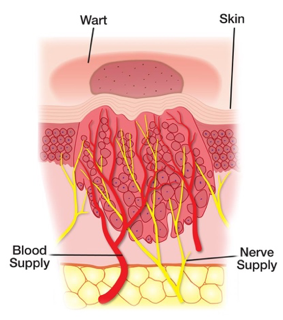
The virus enters through abrasions in the skin’s surface and infects the cells in the deepest (basal) layer of the epidermis. The virus can sit dormant in these cells for many months, until the growth and movement of the cells to the skin’s surface triggers the virus to replicate, changing the shape and appearance of the cells.
Warts under the feet are pushed into the skin because of the pressure from weight-bearing, unlike warts on non-weight-bearing areas (eg Elbow) where the bulk of the wart protrudes.
HPV is spread by shedding infected, surface skin cells into the environment. There is little or no release of viral elements into the blood to alert the body to its presence. Also, HPV has ways of inhibiting the body’s immune response to some degree.
This may explain why the treatment options are not uniformly successful and why treating warts can be so difficult, even in people with strong immune systems.Sometimes, HPV does produce a response from the body, and the wart may resolve spontaneously. This, however, is less likely in adults, and in people with compromised immune systems.
What do they look like?
Warts are often confused for corns or splinters.
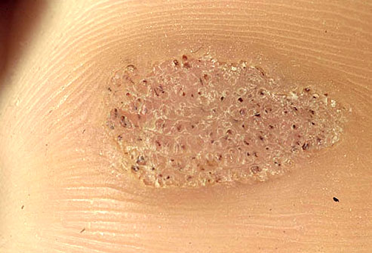
Established warts have a rough surface, often with little black dots.
They often have well defined borders and seem to push between the skin lines.
They are often described as having a cauliflower appearance.
They are typically more painful on sideways pressure as opposed to direct pressure.
Pain is of a throbbing nature – worse when first bearing weight, or off-loading.
Although foot warts are caused by the same virus, they can have variations in their appearance, size, shape, number and location.
Our Treatment Approach for Foot Warts
We understand that foot warts can be bothersome and uncomfortable. Our team of experienced podiatrists is dedicated to providing effective wart removal treatments.
Most treatments work by destroying the infected tissue, with an increased opportunity to present the virus to the body to create a response. The decision on the type of treatment will be made by you, with the guidance of your Podiatrist.
Our approach is tailored to each individual and some of the factors that will be considered include age, general health, systemic conditions, location, size, severity, spread, pain, recurrence, activity, schedule.
Some of the treatments we offer include:
Chemical Therapies
________
This involves applying a special solution containing silver nitrate, salicylic acid and/or other chemicals to the wart, which helps to break down the wart tissue.
Overlying thick skin is shaved down.
Each chemical has a different application protocol, but they all reqire repeated application over a number of weeks.
These are generally less painful treatment options but have extended treatment times
Faulkner Needling
________
This is a minimally invasive procedure that involves the mechanical destruction of the infected cells as well as an inoculation for the body’s immune system to attack the virus from the inside out.
It requires local anaesthetic which may be painful during administration.
It is not gauranteed as a once off teatment, but it is an aggressive option. Read more…
Cryotherapy
________
This involves freezing the wart repeatedly, using liquid nitrogen, causing the wart to gradually reduce.
It does not require local anesthetic but the application of the liquid nitrogen may be uncomfortable.
It requires repeated applications per session, and a number of sessions over a few weeks.
Other Treatment Options
There is a long list of other treatment options for verruca that may be offered by Podiatrists, Doctors and Dermatologists. Choosing, or referring, for these options can be guided by your Podiatrist.
FAQs on Foot Wart Treatments by Podiatrist
Q: Are foot wart treatments painful?
A: Most treatments are generally well-tolerated, with minimal discomfort. Some may cause mild pain or discomfort during and after the procedure. Faulkner needling requires local anaesthetic which may be painful during administration.
Q: Is there a risk of warts coming back?
A: While our treatments aim to completely resolve foot warts, there is a chance of recurrence. Each treatment option and its risks will be discussed with you to decide on the best treatment for you.
Q: How long does the treatment take?
A: The duration of the treatment varies depending on the type and size of the foot wart(s), and the choice of treatment. Some treatments may require multiple sessions over a number of weeks.
Q: Can I walk immediately after the treatment?
A: Yes, our treatment options range from non-invasive to only minimally invasive techniques. Our podiatrists will prepare you as to what to expect after the procedure that is best for you.